Bespoke Fireplaces: Custom Fireplace Design Without Limits By Modus
The term bespoke fireplace is used widely. But what does bespoke actually mean?
At Modus Fireplaces, we believe it should mean exactly that: a fireplace designed around the architecture, the interior and the individual requirements of a project, rather than asking a project to adapt around an existing product.
Sometimes that means altering the dimensions, materials or finish of an existing fireplace. Sometimes it means re-engineering the form completely. And sometimes it means starting with little more than an architect or designer's idea and creating something that has never existed before.
After almost 40 years specialising in luxury and architectural fireplaces, Modus has developed an unusually extensive capability for customisation.
Size, shape, proportion, fuel type, flame, materials, finish, glass, detailing, orientation, technology and integration can all be considered individually.
For the most ambitious projects, almost every element is open to specification. That is what truly bespoke fireplace design means to us.
What is a bespoke fireplace?
A bespoke fireplace is a fireplace created or adapted specifically for the space in which it will sit. Rather than choosing a standard appliance and building the room around it, the design can respond to the architecture itself: ceiling height, room proportions, sightlines, materials, furniture layouts and the way the space is intended to be used.
At Modus, bespoke fireplace design can take several forms. An existing fireplace might be customised through different dimensions, materials or finishes. A standard concept might be significantly re-engineered to work within unusual architectural constraints. Or our design team can develop an entirely one-off fireplace from first principles. This distinction matters.
Customising the colour of a standard fireplace is one thing. Creating a fireplace specifically for an architectural brief is something very different.
Every element of a fireplace can be customised
One of the defining characteristics of the Modus approach is the breadth of what can be changed. Depending on the project, we can customise:
- overall dimensions and proportions
- fireplace shape and geometry
- burner size and flame length
- gas, wood, bioethanol, electric, holographic or vapour technology
- single, double, three-sided or 360-degree viewing
- suspended, wall-mounted, freestanding or integrated configurations
- metal type and finish
- stone and specialist material selection
- glass dimensions and configuration
- fireplace base and hearth design
- surrounding architectural elements
- media-wall integration
- control systems and automation
- indoor or outdoor application
This means the conversation does not need to begin with: "Which fireplace should we choose?" It can begin with: "What do we want the fireplace to do within this space?" That shift in thinking opens up significantly greater design freedom.
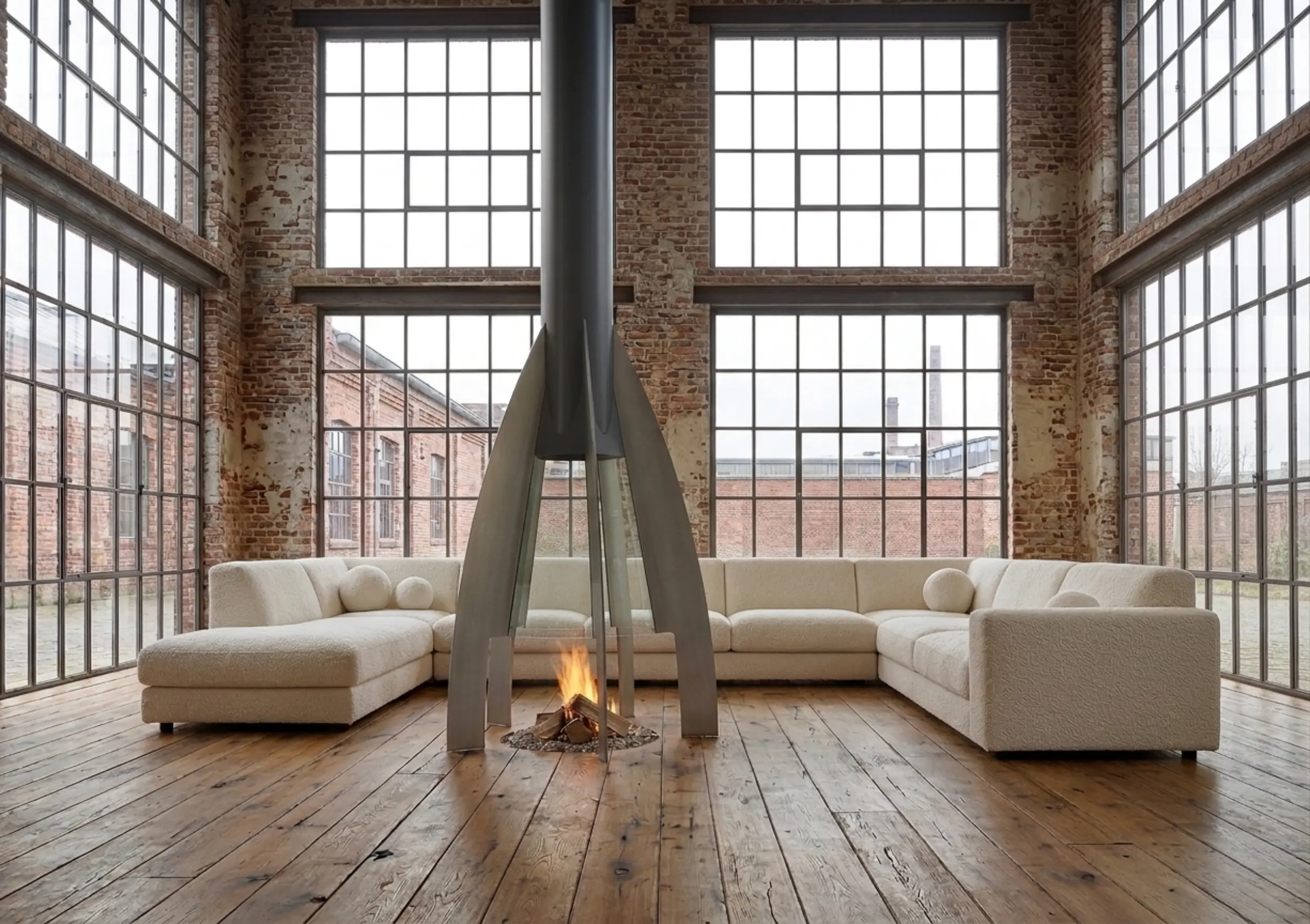
Bespoke suspended fireplaces as sculpture
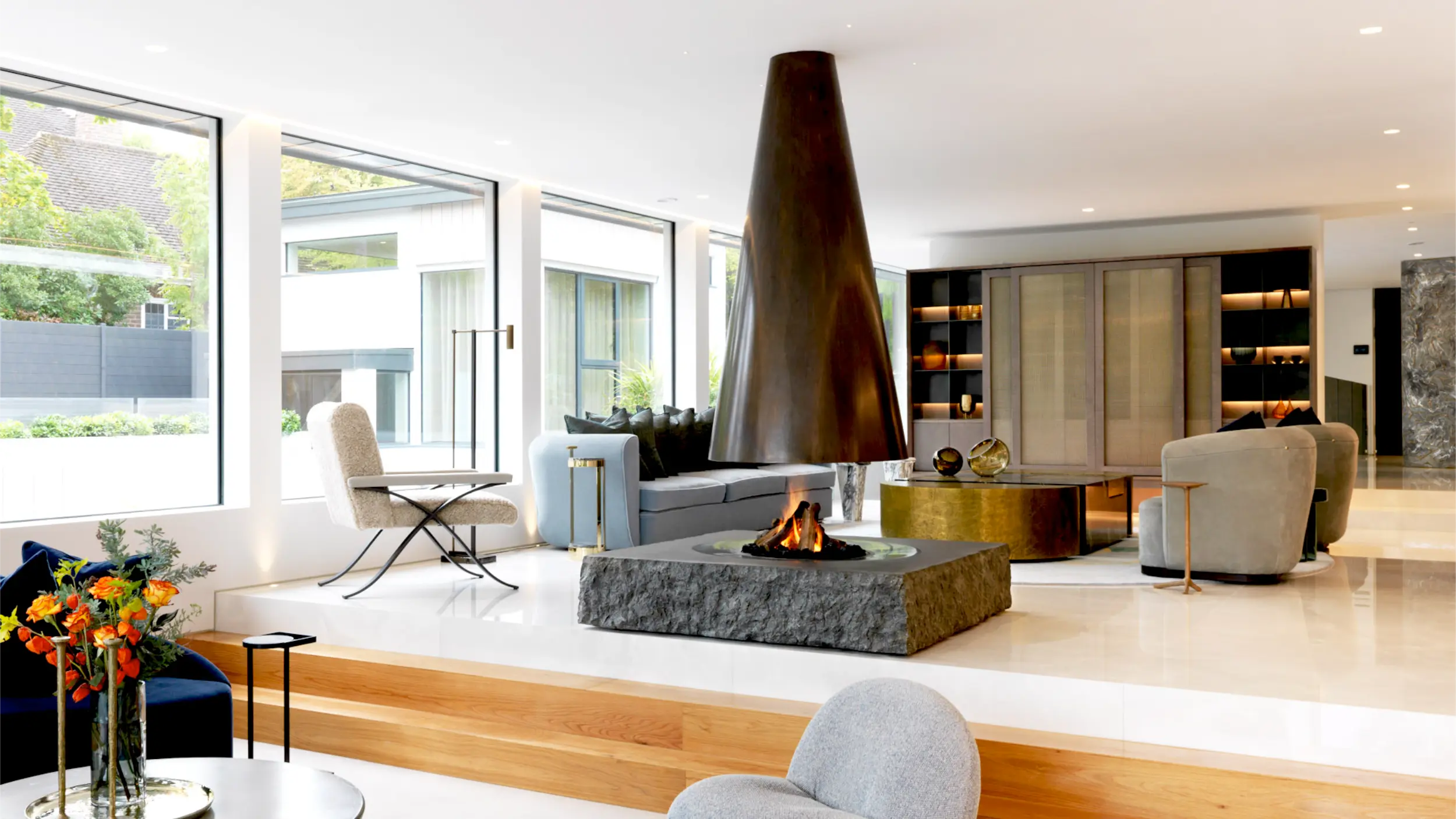
Suspended fireplaces are perhaps one of the clearest examples of what customisation can achieve.A fire suspended within a room is inherently architectural. It can become a sculptural object in its own right, viewed from several directions while preserving openness and sightlines through the space.
Modus has created bespoke suspended conical fireplaces combining metal, glass and individually specified finishes, with proportions developed specifically around the architecture in which they sit.
A canopy can be elongated or shortened. Its diameter can change. The finish might be aged brass, blackened steel, bronze or another bespoke metal treatment.The glass configuration, fireplace base and flame itself can all be developed around the scheme.
The objective is not simply to install a suspended fireplace. It is to create one whose scale, materiality and proportions feel as though it could only ever have belonged in that particular space.
When the fireplace shape itself becomes bespoke
Sometimes the architecture calls for something that simply does not exist as a conventional fireplace.
For one particularly unusual brief, Modus developed a horseshoe-shaped fireplace for a majlis, creating a fire around the way the space was intended to be experienced rather than attempting to adapt a conventional linear fireplace to fit. Projects like this demonstrate the difference between product customisation and genuine bespoke design. There was no standard fireplace to select. The starting point was the desired architectural form. The fireplace then had to be engineered around it.
The UK's longest linear fireplace
Scale is another area where bespoke engineering becomes critical. Modus has designed and delivered the UK's longest linear fireplace, an extraordinary approximately eight-metre double-sided line fire conceived as a continuous architectural feature.
At this scale, a fireplace is no longer simply an object within a room. It becomes architecture. Burner configuration, flame continuity, heat, structure, glass, extraction, servicing and installation all have to be resolved together.
It is precisely these technically ambitious projects that have shaped the Modus approach to bespoke fireplaces: design freedom is only valuable when it can be supported by the engineering required to make the concept work.
Fireplaces that disappear beneath the floor
A fireplace does not even need to remain visible when it isn't being used. Modus has developed fireplaces engineered to rise from beneath floor level at the touch of a button and disappear again when no longer required.
For an outdoor terrace, this creates a particularly interesting possibility. When the fire is wanted, it becomes the focal point of the space.When it isn't, the fireplace can retreat below the terrace, allowing the architecture and views to remain completely uninterrupted. It is a good example of how bespoke fireplace design can extend far beyond choosing materials and dimensions.
Movement, automation and the way a space changes throughout the day can become part of the brief.
Bespoke fireplaces and media walls
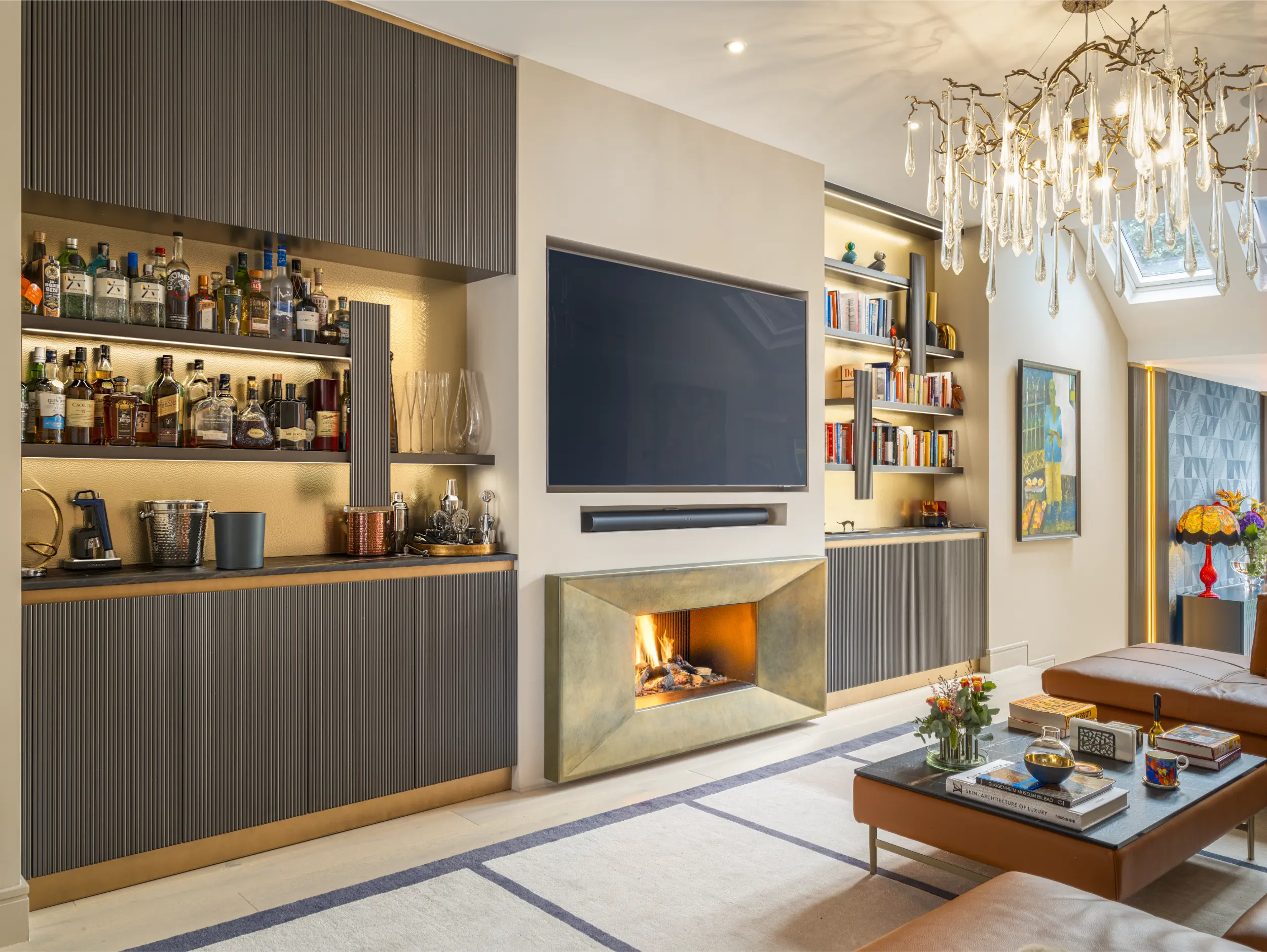
Media walls are now a major part of contemporary interior design, but the most successful examples are those where the fireplace, television, joinery and architecture are designed together.
Modus regularly creates bespoke fireplaces integrated into media walls, with fireplace dimensions, flame position, surrounding materials and heat management developed around the wider composition.
The result can be deliberately dramatic or exceptionally minimal. In some schemes, the television is an integral visual element. In others, it is designed to disappear completely. We have worked on hidden media-wall concepts where screens can be concealed when not in use, allowing the fireplace or surrounding material to remain the principal focus of the room. We can also develop schemes where elements of the interior sit behind retracting architectural wall panels, allowing technology and functionality to be revealed only when required.
This level of integration is particularly important in high-end interiors where the client wants the convenience of technology without allowing a large black television screen to dictate the room.
A bespoke fireplace doesn't have to use traditional fire technology
Design freedom also extends to the flame itself. Modus works across a wide range of fireplace technologies, allowing the solution to be selected around the particular constraints and objectives of the project.
Bespoke gas fireplaces
Gas remains an important option for projects requiring a highly controllable real flame, substantial scale and sophisticated burner configurations.
Bespoke bioethanol fireplaces
Bioethanol allows a real flame to be incorporated without a traditional chimney or flue, creating considerable flexibility for apartments, hospitality spaces and architecturally challenging locations.
Bespoke electric fireplaces
Where combustion isn't appropriate, electric fireplace technology can provide a highly flexible alternative with minimal infrastructure requirements.
Holographic fireplaces
Holographic flame technology opens up further possibilities where the appearance and movement of fire are desired without a conventional combustion system. Modus has used this technology within highly prestigious projects where retaining the architectural form of the fireplace was essential but introducing gas or a flue was not practical.
Vapour fireplaces
Water-vapour flame technology offers another route for creating the appearance of fire without conventional combustion. For the right environment, it can allow designers to introduce flame effects into locations where a real flame would otherwise be difficult or inappropriate. The important point is that with bespoke fireplace design, technology should serve the architecture rather than dictate it.
Bespoke outdoor fireplaces
The same principle applies outside. Outdoor fire has moved considerably beyond the traditional fire pit. Modus designs and supplies bespoke outdoor fireplaces, fire tables, fire pits and architectural fire features that can be tailored around the scale and materials of a garden, terrace, hotel or hospitality space.
Bespoke fire tables
A fire table can be developed in different dimensions, materials and finishes so that it becomes part of the furniture and landscape architecture rather than simply an appliance placed within it. Different burner sizes, configurations and fuel options can be selected according to the setting.
Fire Pots
Our Fire Pots take another approach entirely. Handcrafted garden vessels are transformed into bioethanol fire features, creating portable real flame without a permanent gas or electrical connection. When the fire is not being used, the addition of a lid allows the vessel to become an outdoor table. It is fire conceived as a piece of outdoor furniture.
Bespoke doesn't always have to mean extreme
Some of the most successful bespoke fireplaces are not the most complicated. The starting point might be one of the fireplaces within the Modus collection. The proportion could be changed to better suit the wall; A different metal could be specified to echo joinery or ironmongery elsewhere in the interior; The flame might be lengthened; The base might change from stone to metal; The glass configuration may need adapting; A standard finish might be replaced with patinated brass, textured steel or a stone selected by the interior designer; The fireplace is still recognisably derived from the original concept, but it has been refined until it belongs specifically to that room. This more subtle level of customisation is something we undertake every day.
Bespoke fireplace design for architects and interior designers
The greatest design freedom usually comes when Modus becomes involved early. Fireplaces interact with structure, ventilation, flues, services, joinery, ceilings, surrounding materials and spatial layouts.
For architects and interior designers, discussing the fireplace before these elements are completely fixed means we can help establish what is technically possible while there is still freedom to develop the design. Our in-house design team can work from architectural drawings, sketches, reference imagery or an initial concept.
We then develop the fireplace through design, technical detailing, visualisation and engineering, working closely with the wider project team through to installation. That collaborative process is particularly important for the most ambitious bespoke fireplaces.
An unusual idea does not need to arrive fully resolved. That is our job.
How bespoke can a fireplace really be?
For Modus, there is no simple catalogue answer. We have created:
- sculptural suspended conical fireplaces in bespoke metals and glass
- a horseshoe-shaped fireplace developed specifically for a majlis
- the UK's longest linear fireplace
- fireplaces that rise automatically from beneath the floor
- terrace fires designed to disappear completely when not in use
- bespoke fireplace and media-wall installations
- hidden media walls where technology disappears from view
- fireplaces integrated behind retracting architectural walls
- double-sided and multi-sided fireplaces
- individually designed outdoor fire tables
- bioethanol Fire Pots
- bespoke gas fireplaces
- bioethanol fireplaces
- electric fireplaces
- holographic fireplaces
- vapour-effect fireplaces
And those examples represent possibilities rather than a fixed menu. Because sometimes the most interesting fireplace is the one that hasn't been designed yet.
Bespoke Fireplaces: Frequently Asked Questions
What is a bespoke fireplace?
A bespoke fireplace is designed or customised specifically for an individual project rather than being limited to a standard size, material or configuration. At Modus, this can range from adapting an existing fireplace design to developing a completely one-off fireplace from first principles.
Can every element of a fireplace be customised?
At Modus, virtually every element can be considered individually, including dimensions, proportions, shape, materials, finish, burner technology, flame length, glass configuration, fuel type and architectural integration. The extent of customisation depends on the technical requirements of the individual project.
Can you design a completely unique fireplace?
Yes. Modus specialises in both highly customised existing designs and fully bespoke fireplaces conceived specifically for a project. Previous designs have included an eight-metre linear fireplace, unusual sculptural forms and automated fireplaces that disappear below floor level.
Can bespoke fireplaces be integrated with televisions and media walls?
Yes. Bespoke fireplaces can be designed as part of a complete media-wall composition. Correct heat management, ventilation, materials and detailing are essential, and these are considered as part of the design process.
What fuel can a bespoke fireplace use?
Depending on the project, bespoke fireplaces can incorporate gas, wood, bioethanol, electric, holographic or vapour technologies. The appropriate technology depends on factors including the desired flame, building, ventilation, flue possibilities, heat requirements and design intent.
Can outdoor fireplaces be bespoke?
Yes. Outdoor fireplaces, gas fire pits, fire tables and bioethanol fire features can all be customised in dimensions, materials, finishes and configuration to suit a terrace, garden or hospitality environment.
When should I speak to a bespoke fireplace designer?
For architecturally integrated or technically complex fireplaces, earlier is generally better. Involving a fireplace specialist during the design stage allows structure, flues, ventilation, materials, services and other requirements to be considered before the surrounding architecture is fixed.
Truly bespoke fireplaces start with the idea
For almost 40 years, Modus Fireplaces has worked on the principle that the fireplace should respond to the project — not the other way around.
That may mean adjusting a few carefully considered details.
Or it might mean engineering an eight-metre flame, creating a fireplace in a completely unconventional shape, suspending a sculptural fire within a double-height room or designing one that disappears beneath the floor altogether.
The common thread is the same: the architecture comes first.
If you can conceive it, we can deliver it.
Learn more about our bespoke capabilities here or get in touch with one of our Design Consultants to discuss an upcoming project.